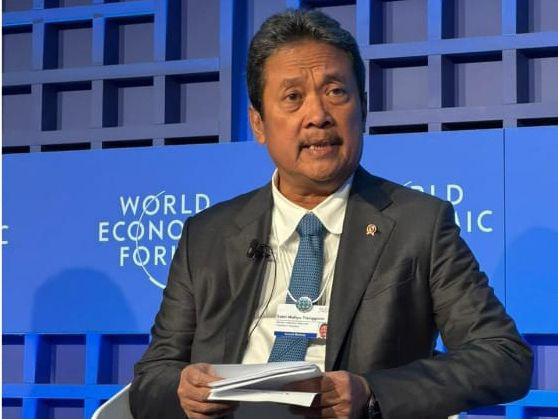
JAKARTA (23/1) – The accelerating degradation of marine ecosystems has become a critical global concern. Coordinated international efforts are essential to restore ocean health from the combined impacts of climate change, pollution, and illegal fishing activities that threaten global fish populations.
This message was delivered by Indonesia’s Minister of Marine Affairs and Fisheries, Sakti Wahyu Trenggono, during the “Velocity of the Blue Economy” session at the World Economic Forum (WEF) in Davos, Switzerland, on Tuesday (22/1) local time.
“Our oceans are facing severe threats: rising temperatures, increasing acidity, declining fish stocks, and marine pollution. The ocean is calling on all of us to act collectively to protect and manage it responsibly,” Minister Trenggono stated.
As an archipelagic nation, Indonesia—through its Blue Economy programs—is prepared to contribute actively to global marine conservation. The ocean has long been an integral part of Indonesia’s history, identity, and future development.
The Minister emphasized the need for rapid, collaborative action between governments, the private sector, and local communities. Among the strategic measures implemented by the Ministry of Marine Affairs and Fisheries (MMAF) is the continuous expansion of marine protected areas. Currently covering over 30 million hectares, these zones are targeted to reach 97.5 million hectares by 2045.
Fisheries management reforms are also being enforced through a quota-based system designed to prevent overfishing and combat illegal fishing activities.
Furthermore, aquaculture development is being bolstered through innovative, sustainable, and inclusive approaches to improve community welfare and support national food security. Coastal areas and small islands are being shielded from economic activities that could degrade surrounding ecosystems. To address marine debris, the Government of Indonesia is integrating land-based and sea-based waste management strategies.
“Indonesia holds one of the world’s largest blue carbon reserves, accounting for approximately 17 percent of global blue carbon. These coastal ecosystems serve as vital carbon sinks and play a significant role in climate regulation and overall ocean health,” he added.
Also speaking at the session, the European Commissioner for Sustainable Transport and Tourism, Apostolos Tzitzikostas, highlighted that the blue economy is not only about economic growth but also concerns global competitiveness and security. To ensure marine sustainability, the European Union is promoting alternative fuels in the maritime and shipping sectors to reduce carbon emissions.
“What we are currently preparing in the European Union is an EU Strategy for Ports and the Maritime Sector, which will address contemporary challenges, including the advancement of the blue economy,” Tzitzikostas stated.
Indonesia to Host Ocean Impact Summit 2026
During the session, Minister Trenggono announced that Indonesia will host the Ocean Impact Summit (OIS) 2026 in Bali in June 2026. The summit will convene global leaders, business executives, and experts to advance concrete actions for sustainable ocean governance.
The Velocity of the Blue Economy session was attended by representatives from various nations and international organizations. Ocean issues have become a top priority at WEF 2026, marked by the launch of the “Blue Davos” initiative and the designation of 2026 as the “Year of Water.”
These initiatives reflect integrated efforts to strengthen the governance of marine and freshwater resources to support economic stability, climate resilience, and food security.
Source: Ministry of Marine Affairs and Fisheries, Republic of Indonesia