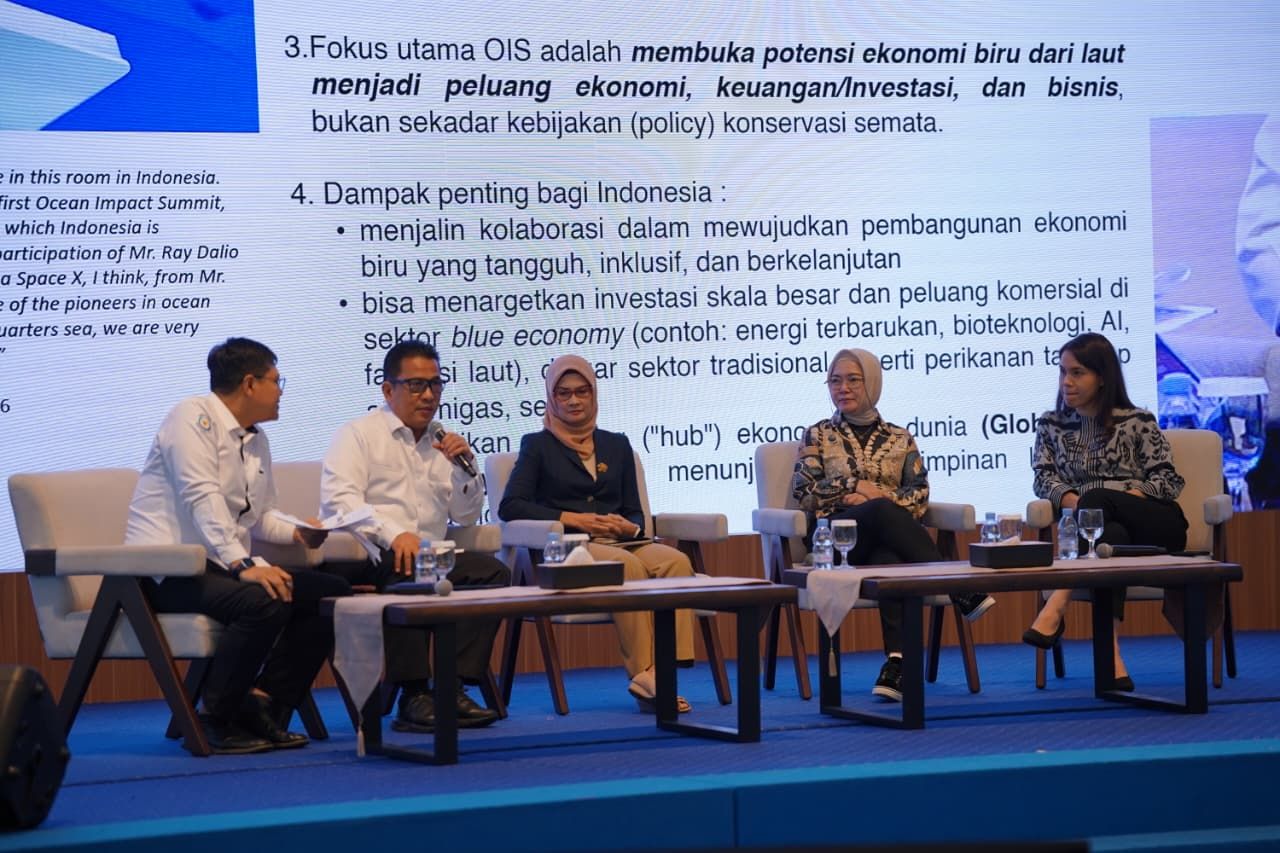
JAKARTA (14/2) – The Ministry of Marine Affairs and Fisheries (MMAF) is ensuring public information transparency from the preparation stage through the implementation of the global Ocean Impact Summit (OIS) 2026, which will take place in Bali on 8–9 June. This effort aims to build investor confidence in Indonesia’s marine sector.
In the context of OIS 2026, information transparency serves as a key enabler for Stream D – Ocean as a Governance & Innovation System. This approach treats the ocean not only as a resource but also as a governance system that requires open data, innovation, and multi-stakeholder participation.
“This is an important part of developing the blue economy—unlocking the ocean’s economic potential will contribute to economic growth, public welfare, and state revenue,” said Hendra Yusran Siry, Senior Adviser on Ecology and Marine Resources Affairs, in an official statement in Jakarta on Saturday (14/2).
MMAF’s Public Information Disclosure Forum, held yesterday, also discussed the urgency of implementing OIS 2026 to strengthen Indonesia’s marine economy. Investment potential in the marine sector remains significant, particularly in areas that have not yet been fully explored. These include deep-sea commodities for the pharmaceutical industry and the abundant red algae species found in Indonesian waters, which can serve as a key raw material for environmentally friendly or biodegradable plastics.
According to Hendra, attracting investment requires complete, credible, and easily accessible data. Policy information is also important for investors as a basis for decision-making.
“Transparency builds trust. Without transparency, there is no policy legitimacy. Without trust, there is no collaboration. And without collaboration, achieving real impact in the blue economy is difficult,” he said.
MMAF focuses on three key aspects in implementing public information transparency: open data, the use of technology, and a commitment to building public trust. To support this, the ministry continues to strengthen the quality, integration, and accessibility of marine and fisheries data so it can be utilized by the public, researchers, and investors.
Adita Irawati, Senior Expert at the Government Communication Agency (Bakom RI), emphasized the importance of a strong communication strategy to promote the blue economy ahead of OIS 2026. She noted that collaboration across stakeholders is necessary to ensure information is disseminated widely, effectively, and measurably.
“The overarching narrative is about unlocking the blue economy’s potential. Together with MMAF, this will be translated into specific narratives on what that potential actually looks like—for example, the ocean as a center of economic activity, a source of energy, a reservoir of biodiversity, and a foundation for coastal resilience. These narratives need to be conveyed in simple language and supported by monitoring tools to track public discussions,” she explained.
Meanwhile, to accelerate the processing of marine and fisheries data in support of public information services, Sri Safitri, Secretary General of the Partnership for Collaboration Research and Innovation in the Artificial Intelligence Industry (Korika), encouraged the adoption of artificial intelligence (AI). With current technology, data processing can be faster, more dynamic, and conducted in real time.
“AI provides tools to see what is not visible, such as detecting anomalous vessels in real time. It can also support predictive modeling of fish stocks, risk-based enforcement, dynamic quota systems based on ocean currents and temperature, and automatic complaint scoring,” she said.
She added that as one of the world’s largest and most complex marine laboratories, Indonesia is currently in an important transition—from archipelago to algorithm. The country should become a leader in AI-based ocean governance for a sustainable future, rather than relying solely on resource management.
“We can no longer manage the ocean in the 21st century using a 20th-century system. Ships move every minute, and so do fish. This is Indonesia’s moment to lead in relation to the Ocean Impact Summit,” she explained.
Previously, Minister of Marine Affairs and Fisheries Sakti Wahyu Trenggono stated that the first OIS, to be held in Bali this June, aims to unlock the blue economy’s potential into economic, financial, investment, and business opportunities. MMAF targets the creation of large-scale investment and commercial opportunities in the blue economy sector, particularly in marine pharmaceuticals, while positioning Indonesia as a gateway for the marine economy in Southeast Asia.
Source: Ministry of Marine Affairs and Fisheries, Republic of Indonesia